The Puffy Coat Car Seat Danger (And How We Actually Stay Warm Without It)
Puffy winter coats flatten instantly under the force of a crash, leaving dangerous slack in car seat harnesses and booster seat belts. Keep kids safe in freezing weather by dressing them in thin merino wool base layers and fleece, buckling them snugly, and throwing their heavy coat on backwards over the buckle.
On this page
Listen, the temperature in Colorado Springs just took a massive nosedive off a cliff this week. One morning we had crisp fall sunshine, and the very next morning I walked out onto the porch at 6:45 AM to let the crisp mountain air slap me wide awake, only to find the truck windshield coated in a solid sheet of crusty mountain ice. Winter has arrived, friends, and she did not knock politely.
Every single year when the first freeze hits, the great winter coat car seat debate erupts across the internet. You have probably seen the crash-test videos—the terrifying slow-motion clips where a crash-test dummy kid literally slips right out of their seatbelt because they were bundled up like a tiny, puffy marshmallow. If you haven’t seen those clips, consider yourself warned: they will make your stomach drop straight through the floorboards.
Yet every single morning at kindergarten drop-off, I still watch dozens of well-meaning parents march their kids out of minivans and crossovers, strapped tight into car seats and boosters wearing massive, down-filled snow parkas that look like miniature sleeping bags. I get it. I really do. It is thirty degrees outside, the wind is ripping down off the peaks, your hands are numb, and every mama instinct inside your body is screaming at you to bundle your baby up until they can barely bend their elbows. The thought of taking that warm, cozy jacket off before buckling them in feels cruel, chaotic, and completely counterintuitive.
Here is the cold, hard truth: that big, fluffy winter coat is one of the most dangerous things your child can wear in a moving vehicle.
Navigating this safely without turning your daily morning routine into a screaming wrestling match is entirely possible. Let’s break down the actual physics of why puffy coats fail, how this applies to older kids in booster seats, and the exact, sanity-saving layering system we use to keep my stubborn five-year-old warm, safe, and buckled properly in our truck without losing my mind before 8:00 AM.
Why is a puffy winter coat actually dangerous in a car seat?
To understand why heavy jackets are such a hazard, you have to look at how winter coats are engineered. Whether a jacket is filled with synthetic polyfill or genuine down, its warmth comes almost entirely from trapped air. All that lovely fluff creates pockets of dead space that hold onto body heat. That is fantastic when your child is running around the backyard, digging trenches in the dirt, or building forts.
In a moving vehicle, however, that trapped air becomes a silent hazard.
When a vehicle experiences a sudden collision—even at relatively low neighborhood speeds like twenty-five or thirty miles per hour—the kinetic forces exerted on the human body are astronomical. In a crash, that puffy layer of air inside the jacket compresses instantly under the violent pull of the seatbelt. It flattens down to almost nothing in a millisecond.
If you strapped your child in over a heavy puffer jacket, you pulled the straps snug against the outside of that bulk. You thought they were securely buckled because the harness felt tight against your hand. But the moment an impact occurs and that fluffy fill flattens out, you are suddenly left with anywhere from two to four inches of sheer, empty slack between your child’s body and their restraint system.
Here is what happens when that empty slack appears during a crash:
- The harness slips completely off the shoulders: When the straps are too loose, a child’s upper body violently hinges forward, easily slipping out of the shoulder straps entirely.
- Total seat ejection becomes a real possibility: In high-speed impacts, children can be thrown completely free of their car seats because the restraint system was never actually pinned against their skeletal frame.
- Violent rebound forces cause severe head trauma: Slack allows the body to travel much farther forward before catching, causing the head and neck to snap back with exponentially more violent whiplash forces.
- The chest and abdomen absorb dangerous blunt trauma: Instead of the harness spreading the impact forces evenly across the strongest pelvic and shoulder bones, loose belts snap aggressively into soft tissue.
It is terrifying to think about, but recognizing the physics makes the fix obvious. The car seat or vehicle belt must sit directly against your child’s body to hold them in place. Fluff simply does not hold anyone safe in a collision.
Does the puffy coat rule still apply if your kid is in a booster seat?
There is a massive, incredibly common misconception floating around school drop-off lines that once your child graduates out of a five-point harness and moves into a booster seat, the puffy coat rule no longer matters.
I hear this all the time: “Well, Luke is in a booster now using the regular truck seatbelt, so we don’t have to worry about harness compression anymore, right?”
WRONG. A thousand times, no. In fact, wearing a thick winter coat inside a booster seat can be just as hazardous, if not worse, because of how booster seats are fundamentally engineered to work.
A booster seat does not restrain your child on its own. Its only job is to properly position the adult vehicle seatbelt across a child’s smaller skeletal framework. Specifically, a high-back booster is designed to keep the lap belt resting low and flat across the strong pelvic hip bones—never across the soft belly—and to route the shoulder belt directly across the center of the collarbone and sternum.
When you sit a five-year-old down in a booster wearing a giant winter parka, that thick, slippery fabric disrupts the entire geometry of the seatbelt.
First, the lap belt cannot sink down into the pelvic crease where it belongs. Instead, it rides up high onto the squishy puffer coat, hovering directly over your child’s delicate abdominal organs. If you get into a front-end wreck, that lap belt will not catch on their strong hip bones. It will slice straight upward into their stomach, intestines, spleen, and liver. In severe cases, the child slips right underneath the lap belt entirely—a catastrophic crash scenario known as “submarining.”
Second, the shoulder belt ends up sitting on an unstable, slippery pile of nylon. During a collision, the slick fabric allows the belt to slide right off the shoulder, leaving the child’s upper body completely unrestrained as they whip forward toward the front seatback.
Luke outgrew his five-point harness early because he is built long and tall like his dad, and he has been riding in a high-back booster seat for a while now. Even though he is a big, independent kindergartener who insists on doing everything himself, the puffy coat rule remains strictly non-negotiable in our truck. Whether your little one is an infant strapped into a bucket seat, a preschooler in a convertible seat, or a five-year-old buckled into a high-back booster, bulky outerwear does not belong beneath a seatbelt. Ever.
How do you know if a coat is too thick? (The quick pinch test)
I know what you are thinking, mama. “Annie, does this mean my kid has to ride in the car wearing just a t-shirt in sub-zero weather? What about a fleece jacket? What about their lighter fall coat? How do I actually know what is safe?”
You do not have to guess, and you definitely do not have to leave your child shivering. There is an incredibly simple, foolproof trick you can do right in your driveway to test any piece of winter clothing in less than two minutes. It is called the Compression Test.
Here is how you test any jacket or layer:
- Put the jacket on your child and buckle them into their car seat or booster seat exactly as you normally would before heading out the door.
- Snug the seatbelt down comfortably. Make sure all the slack is taken out so the belt rests firmly against the jacket.
- Unbuckle the seatbelt WITHOUT adjusting or loosening it. Tell your kiddo to sit still for just thirty seconds, slide them carefully out of the seat, and take the jacket off.
- Put your child right back into the seat in their regular indoor clothes. Buckle the seatbelt again without touching the retractor or pulling the adjuster strap at all.
- Check for slack. Does the seatbelt lie flush, flat, and snug against their chest and hips? Or can you easily fit multiple fingers underneath the belt? If you can grab a fistful of loose belt webbing, or if the lap belt hangs loosely away from their hips, that jacket is too thick to be worn under a seatbelt.
If the belt still rests snugly against their collarbone and hips without you needing to take up inches of leftover slack, congratulations! That layer is safe for the car. Most medium-weight fleece jackets, wool sweaters, and thin packable jackets pass this test with flying colors. The heavy down coats, thick ski jackets, and quilted parkas fail every single time.
What we actually do instead: our frigid-morning layering formula
Now let’s talk real life. How do we keep our kids legitimately warm when the Colorado wind chill is in the single digits, Hubs is waving goodbye from his home office window, and we have to make the kindergarten bell before the tardy buzzer sounds?
My morning sanity relies entirely on ditching bulk in favor of smart, natural layers. Luke wakes up at 6:45 AM on school mornings, and our house is usually chilly before the heat kicks into high gear. While he devours a hot, scratch-made breakfast—usually thick slices of homemade sourdough French toast drenched in real butter—I get his clothes sorted.
Here is the exact cold-weather layering formula that keeps him completely toasty without compromising his booster seat safety:
1. The breathable merino wool base layer
We steer clear of sweaty, static-filled synthetic thermals. A fitted, high-quality merino wool long-sleeve top is our secret weapon. Merino wool is magic: it is completely breathable, ridiculously warm, naturally temperature-regulating, and so thin that it fits like a second skin. It never interferes with seatbelt fit, and it keeps him from sweating when he gets into his warm kindergarten classroom.
2. A fitted fleece or wool mid-layer
Over his base layer, Luke usually wears his favorite camo crewneck or a fitted full-zip microfleece jacket. High-density fleece provides incredible insulation without the hollow air pockets found in puffy coats. Because fleece does not compress dramatically under pressure, a fitted fleece jacket passes the driveway compression test every single time. It keeps his core warm during the three-minute walk to the truck and stays on the entire drive to school.
3. Warm extremities are non-negotiable
Children lose heat fastest through their heads, hands, and feet. Before we step outside, Luke pulls on thick wool socks, sturdy cold-weather boots, and a warm beanie that covers his ears. If his feet and head are warm, his core stays comfortable even if he isn’t wearing an enormous outer parka for the ten-minute drive.
The genius hacks that stop the 7:15 AM kindergarten jacket meltdown
If your five-year-old is anything like mine, logic alone does not always win the morning. Luke is sweet as pie, but he is fiercely stubborn and has very strong opinions about his clothes (if it were up to him, he would wear full hunting camo gear and his beloved Burlebo backpack twenty-four hours a day, seven days a week). Telling a stubborn kid, “Take your coat off, honey, it’s twenty degrees outside!” is a prime recipe for a full-blown front-porch meltdown.
Instead of fighting that battle every morning, we use three practical strategies that keep everyone safe and tear-free:
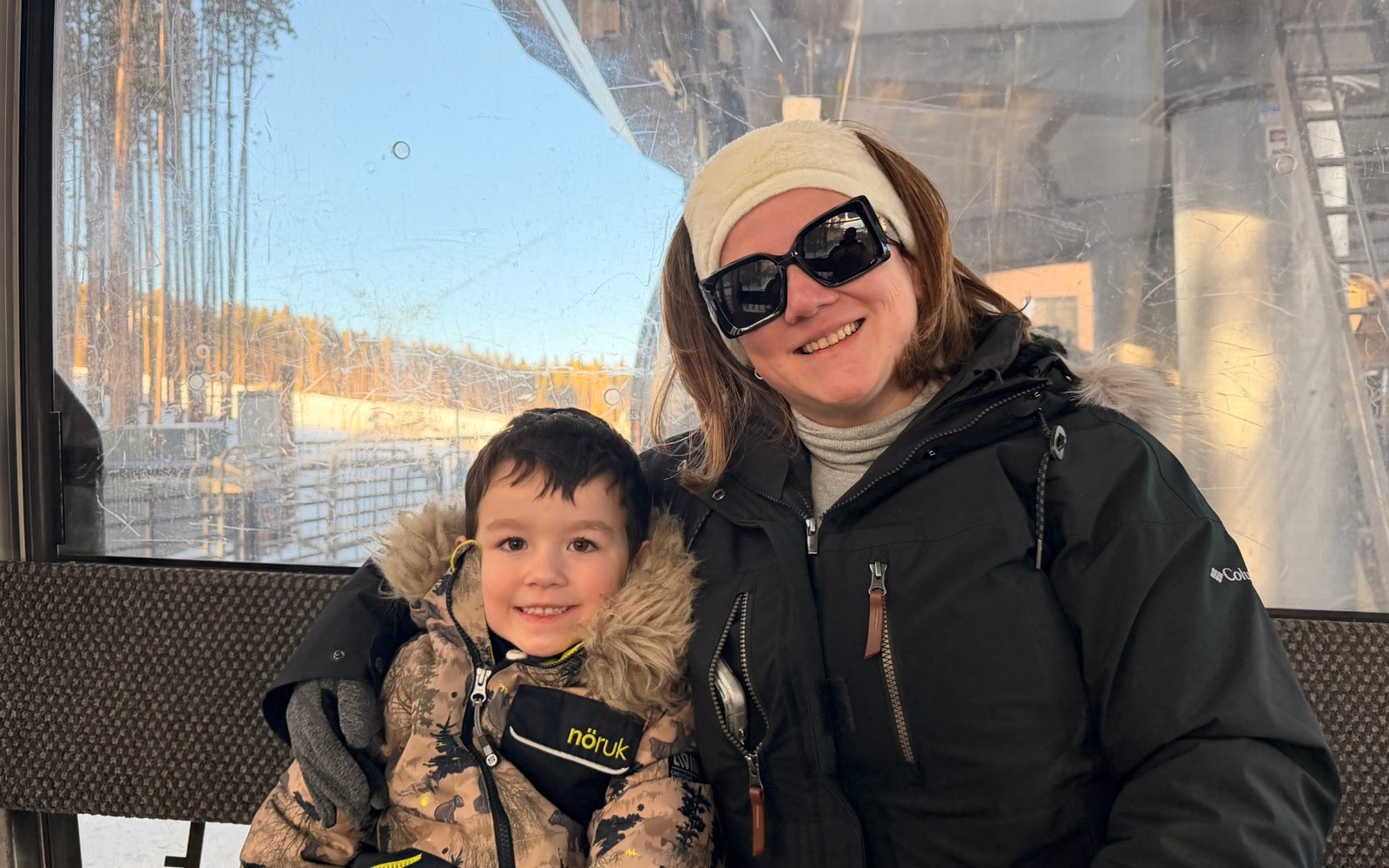
- The Backwards Coat Trick: This is hands-down the greatest winter parenting hack in existence. We put Luke in his heavy winter coat to walk out the front door and down the driveway. Once we reach the truck, he slips his arms out of the sleeves, hops into his booster, and buckles the truck seatbelt securely over his fleece layer. Once the belt is safely locked, he simply slips his arms back into the sleeves of his coat backwards, pulling the jacket over his chest and lap like a wearable blanket. The belt stays directly against his chest, and his front is completely shielded from any chilly drafts.
- The Dedicated Truck Blanket: We keep a thick, plush throw blanket folded neatly on the floor of the truck cab. When it is brutally cold outside, Luke buckles his seatbelt, clicks it in place himself, and then pulls his warm blanket right over his lap and legs. He feels like he is bundled up in a cozy nest, he stays entirely warm, and the safety belt remains completely unobstructed underneath.
- The Quick Cab Warm-Up: If the windshield is frozen solid, I step outside five minutes early, fire up the truck, and turn the defroster on high while Luke finishes packing his backpack inside. By the time we climb in, the cab is already taking the edge off the freezing air, meaning there is zero reason for him to sit in a giant coat during the commute anyway.
Our go-to winter morning checklist before we climb into the truck
When you are juggling the morning rush—making lunches from scratch, brewing hot coffee, finding lost shoes, and getting out the door before the morning bell rings—it helps to have a quick mental checklist you can run through automatically.
Before you turn the key in the ignition, take a quick ten-second glance in the rearview mirror:
- No bulky outerwear beneath the belt: Heavy puffy coats, snowsuits, and thick down vests are removed and tossed in the back seat or worn backwards.
- Lap belt position: The lap belt rests low across your child’s upper thighs and pelvic hips, touching bone—not squished into their soft belly or hovering over bunched-up fabric.
- Shoulder belt position: The shoulder belt sits flat across the middle of their collarbone, snug against their chest, without slipping off the edge of the shoulder.
- The zero-slack check: Give the shoulder belt a gentle upward tug at the buckle to remove any remaining slack so the system can do its job instantly if needed.
- Warmth secured: Backwards jacket pulled up, cozy fleece blanket tucked over their lap, and beanie pulled down snug.
Drop-off mornings can feel chaotic, exhausting, and impossibly rushed. But keeping our kids safe in the car does not require fancy gadgets, endless arguments, or sacrificing their warmth in freezing weather. It just takes ditching the puffy jacket myth, building a smart layering routine, and letting a warm blanket do the heavy lifting.
You’ve got this, mama. Stay warm out there!
Affiliate link — if you sign up or buy through it, My Mama Mode may earn a small commission at no extra cost to you. As an Amazon Associate, My Mama Mode earns from qualifying purchases. My Mama Mode also participates in other retailer affiliate programs. Learn more.
Frequently asked
No. Even if you pull the harness as tight as possible, the air trapped inside the coat flattens instantly during a crash, creating dangerous slack that allows your child to slide out of the seat.
No, puffy coats are equally dangerous in booster seats because the slick, bulky fabric pushes the vehicle lap belt up into the child's soft abdomen and allows the shoulder belt to slide off the shoulder.
Thin merino wool base layers, fitted fleece jackets, lightweight cardigans, and non-bulky softshells are safe as long as they pass the driveway compression test without creating leftover belt slack.
Tap the one that fits, mama — no comment box, no pressure ✦
Keep reading, mama

What Nobody Warns You About Your First Kindergarten Parent-Teacher Conference
Sitting in a tiny chair getting real feedback on your five-year-old is wild. Here is what to actually expect at your first kindergarten conference.

How We Finally Split the Mental Load (Without Big Fights or Resentment)
Feeling overwhelmed as a stay-at-home mom? Here is how Hubs and I divided our household mental load, dropped resentment, and restored peace.

How We Survive the 'Fall Back' Time Change with a 5-Year-Old Early Riser
When your 5-year-old already wakes at 6:45am, Daylight Saving Time threatens a 5:45am nightmare. Here is our real-life, sanity-saving survival plan.